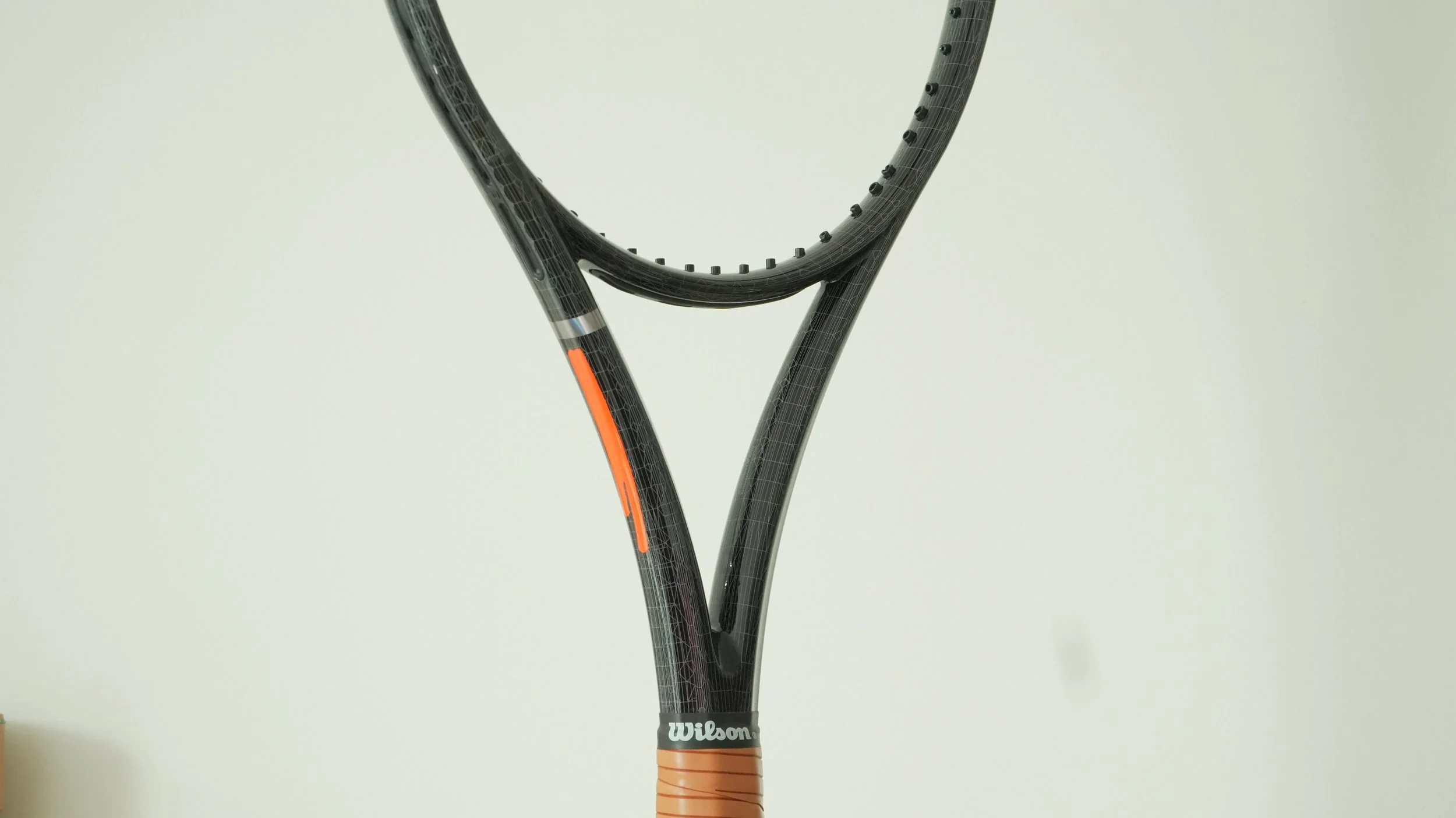
Here’s everything you need to know about the Wilson Python 98. I mean Redline 98. I mean Defyer 98 Pro!
The specs:
98 square inches.
16x20 string pattern.
305g unstrung.
31.5cm balance.
283 swingweight.
What’s crazy about this racquet lies beyond the spec sheet. When was the last time a racquet was so good that it won professional titles and finals before it was even released to the public? Khachanov made the finals at the Toronto Masters 1000 last year. Korda won the Delray Beach ATP 250 this year. The racquet has also seen some home-town hero slam runs, with 17-year old Moise Kouame making the 3rd round at Roland Garros this year and wild card Arthur Fery, ranked 114, flying into the Wimbledon semi finals.
So in article, I’m going to tell you where the new Wilson Defyer sits in the marketplace, why some existing Python reviews might seem to be contradictory, why I think the frame works so well on the professional tour and I’m going to cover how I get the most out of this frame at the recreational level.
Prototype Disclaimer
The reason existing reviews might be a bit contradictory is because not every Python prototype is the same. I personally have 3 of them and I’ve also hit the retail version that Wilson provided Luca. All 3 of my prototypes feel slightly different. This blacked out one is the most raw, most connected and more pure feeling. This snakeskin one with the Luxilon dampener is still raw but a bit softer and the third one with a green dampener feels very similar to Luca’s retail Python, meaning it's the most dampened with the most ball pocketing and plushest feel. In fact I’m pretty sure this one is the retail layup. Though my 3 Pythons all have different hitting feels, the performance of all 3 of them, as well as Luca’s retail, was essentially identical. The softer the hitting feel, the more perceived control I experienced and the more raw the hitting feel, the more perceived power I experienced.
Note that I say “perceived” because I’m not convinced my ball quality changed much between them. Soft or stiff, all the Pythons allowed me to penetrate the court with power, offered plenty of stability for taking the ball early, swung incredibly quickly through the air and delivered the control I needed to stay confident in my shot making. I think the main difference between these 4 Pythons is mainly just the hitting noise and feel.
Market Report
So how does the Python play? Power-wise, the Defyer is on the lower end compared to other spin 98’s. Racquets that are higher on the list have some combination of higher stiffnesses, thicker beams or higher swingweight. There is certainly enough power here for the modern game and I wouldn’t consider this to be a “low powered” frame.
I’m getting solid court penetration on my shots and quite a bit of juice on my serve. The key with the Python is that the power comes from your swingspeed, not from the frame itself. This means we get a ton of maneuverability so that you can accelerate the racquet fast enough to produce a quality shot.
The problem with high maneuverability frames is that they often lack stability. The Defyer has an impressive maneuverability to stability ratio, delivering one of the fastest swinging playing experiences without sacrificing too much stability. In some ways, it’s the complete opposite of the 2026 Pure Aero 98, a racquet that was loaded up with hitting weight, making it plow through the ball like a truck if you had the strength to wield it.
Stability isn’t going to be quite as high as some other frames that accomplish stability with raw numbers, like that Aero 98 with a high swing and twistweight, or the SX300 Tour with its massive beam thickness. Thankfully stability is strong enough for most of us mortal players. I did not feel the need to add weight to this frame to stop it from shaking or twisting in my hand.
With great swingspeed requires great control. Without control, how are you going to find the confidence to go after every single shot? The control on the Defyer is above average for a few reasons. The 16x20 string pattern is quite uniform, delivering a predictable and consistent response throughout the hitting surface. This is not one of those racquets that’s tight on-centre and more open towards the perimeter of the frame. Instead, the string spacing is quite evenly spaced throughout. This leads to a more localized ball pocketing effect so you can really feel where you made contact on the stringbed. The launch angle is on the low side for a spin racquet. It’s not quite as low or control oriented as the Extreme Pro, but traditional control here is far beyond your usual suspects in the Aero, VCORE and SX300 Tour.
Optimal Playstyle
The main thing with the Defyer is that the racquet truly demands high swingspeeds. I found this racquet to play best on the front foot. It’s not that you need to be going for a winner on every shot, it’s that the racquet requires commitment and intention. I can totally see how this racquet has amassed such a following on tour already. A pro player has the natural swingspeeds and athleticism to make the most of this racquet without adjustment.
Even though the Defyer is a “spin racquet,” it rewards striking through the ball far more than lifting and brushing. I see two primary ways one can define a “spin racquet.” There are spin racquets that accentuate already spin friendly techniques. For example, the Head Extreme racquets are designed specifically for players with more vertical swings. There’s also racquets like Babolat’s Pure Aero’s which were aerodynamically tweaked for faster vertical acceleration. And then there are spin racquets like the Defyer which boost the power and spin of a flatter technique.
There’s a reason we are seeing so many Blade users, on Tour and at college level, switch so seamlessly from a “flat hitting control racquet,” to a spin racquet like the Dyfer. The Defyer isn’t a racquet for spin players, it’s a racquet for ball strikers who need more spin.
Feel
The hitting feel on the retail Defyer reminds me most of a Blade. It’s not identical to the V10 Blade, but you get the same muted-solidness that Wilson has employed since the V8 Blades.
There’s zero spongy Clashiness that we’ve seen in the Blade 100, Ultra 100 and Clash line, the hitting feel is closer to what I’ve come to expect from the Prolabs racquets, the Blade 98, the Ultra 99 Pro and the Blade 100 Pro. There’s a nice amount of ball-pocketing and enough connection to the ball that you can feel exactly what’s happening on the stringbed.
The feel is definitely firmer than the Blade, but less firm than any generation of Aero 98. There’s absolutely zero hoop flexing which adds to the sensation of control but enough ball-pocketing to reward touch oriented shots like slices and droppers.
I personally prefer the more connected feel of some of my prototypes, but I suspect the majority of people will enjoy the more dense, solid and soft feel of the retail version.
Personal Thoughts
Ultimately, I love this racquet. Maybe I’m just falling for the hype but I think if you look at the hitting footage from today’s video, that I’m playing pretty dang good with the Python. The racquet encourages me to go after every shot with intention, both with the carrot and the stick. Due to the lower swingweight, the racquet just doesn’t produce a very heavy ball until you go after your shot. Playing safe, high margin tennis was not very rewarding with this frame as my ball would just sit up and get gobbled by my opponent.
As I started increasing my swingspeed to hit through the court, I felt that my shot quality increased almost exponentially with my swingspeed. It was like if I swung 10% harder, I was producing a ball that was 20% better. This leads to a tremendously rewarding experience because it feels like your efforts pay off, with interest.
Customization
I tried a few different setups in the frame, including weight at 3/9, weight at 12 and in stock form. Truly I preferred the frame most stock because I needed all the swingspeed I could get. The weight at 3/9 worked well for us too, providing a more solid feel, better stability off-centre and enhanced plow through. But ultimately, I enjoyed the character of the racquet a lot in completely stock form and felt like that provided the most amount of fun-factor on court.
String Setups
We tried many string setups, ReString Zero, M8 1.30, Sniper/Sync, ALU Power, RPM Blast and a full bed of ReString Sync. My favourite setup so far was a full bed of ReString Sync. If the Defyer is the spin/power version of the Blade, then Sync is the spin/power version of ALU Power. You get that crisp, connected, rewarding hitting feel with decent ball-pocketing combined with the enhanced spin and ball-penetration from Sync’s elite snapback.
Generally, I think the Python works best with a round string to encourage the linear ball striking and enhance the directional control you need to stay on the front foot with this frame. A more connected string is advantageous to cut through the more muted, plush feel of the retail version. Zero and Blast were not the best fit because they just weren’t connected enough for my preference.
Final Thoughts
Overall, I think Python is a tremendously good racquet. It deserves its place in the market place, combining the best elements of the Blade 98 and the Aero 98, prioritizing high-swingspeed performance and attacking control in a package that’s perfect for the modern game.
My only concern is that Wilson might be cannibalizing themselves here. 20 years ago, they released the Blade which slowly ate up all the sales of the 6.1 95, putting the Prostaff line in a palliative care.
Now, I think the Defyer will do the same thing to the Blade.
Wilson has always found a way to maintain a leading “player’s racquet silo,” but they’ve failed to sustainably produce other long-term racquet lines, with the Steam, Juice, Burn and Shift disappearing after only a few years and the Ultra failing to lead its segment with any iteration.