

TennCom String Guide
Why Do I Care?
Shopping for tennis strings is either the most exciting rabbit hole you’ve dive down this month or the greatest, most overwhelming pain in the ass you’ve ever encountered. Ever string claims more power, control and spin without any drawbacks. And why not believe them? Polyester strings are all just pieces of plastic anyway right? Well, honestly, maybe, but I think it’s super fun to experiment with different poly’s anyway. Who cares what the haters say?
Shapes
Poly’s come in several different shapes:
Round (Circle)
Square (4 sides)
Pentagon (5 sides)
Hexagon (6 sides… am I really explaining this?)
Heptagon (7 sides, I bet you didn’t know hepta)
Octagon (stop sign shape)
These 6 are the most common. Generally, the more acute the angle of the corner, the higher the launch angle. This means that square shaped strings typically have the highest launch angle and round strings have the lowest launch angle.
There is one other thing to consider and that’s the sharpness of each corner. For example, there are a few 7-sided strings, like Grapplesnake Soldier and Tourna Silver 7 Tour, which have sharper edges than some 5-sided options, like Grapplesnake Tour Sniper. In some cases, the sharpness of the corner will raise the launch angle, likewise, the roundness of a corner can lower the launch angle.
Typically the more aggressive the shape, the greater the ball-bite, which accentuates the sensation of creating spin on the ball. The downside of the shape is that it can sometimes compromise consistency.
I personally don’t like strings that are too aggressively shaped. I rarely find that they are the best option for players so we don’t carry extreme options that sacrifice too much control.
Gauges
Strings come in a variety of thickness (gauges). Sometimes you’ll see them noted as 16g, 17g, or even 16L (16 light) and other times you’ll find them noted in milimetres, 1.25mm, 1.20mm etc.
Annoyingly, gauge is not standardized across brands, so sometimes you’ll see some variance. For example, Solinco’s 17g is a 1.20mm thickness and Toroline’s 17g is a 1.23mm thickness. Because of this, I tend to focus more on the milimetre rating as opposed to the gauge.
Even more annoyingly, not ALL milimetre thicknesses are created equal. When a string’s gauge is rated, it’s measured from edge to edge. This means that square strings typically carry more volume than an equivalent round string.
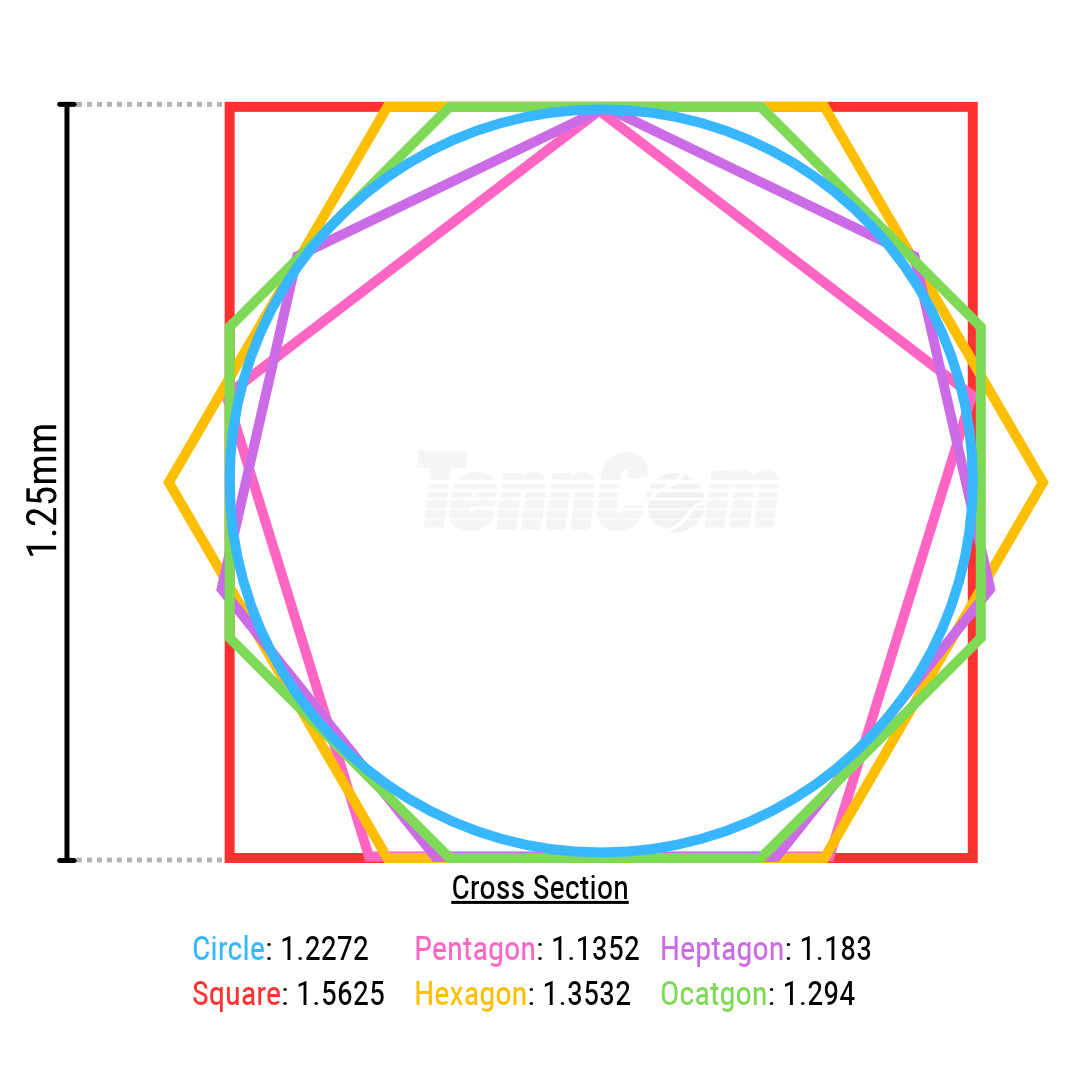
Generally, I don’t worry too much about lining up the gauge to the shape of a string UNLESS the shape is full square, like Grapplesnake Game Changer, which is a 1.20mm square string that plays more like a 16g.
If players are making one string mistake, it’s that they are using too thick of a gauge. The majority of strings are around 1.25mm ± 0.02mm, or 17/16L.
Benefits of Thin Strings:
Better playability at lower swings speeds. Thinner strings are easier to displace, meaning less swingspeed is required to generate snapback, the whole point of poly.
A more connected feel. Thinner poly’s typically feel crisper and more connected. A lot of this is due to the above.
Better ball bite, the thinner strings can dig into the ball more aggressively.
Better comfort. Thin strings are softer so they’ll stretch more at lower swingspeeds and absorb shock more easily.
Downsides of Thin Strings:
The break more easily. This isn’t a big deal with polyester strings because they durability is already so much better than nylon. 18g (or strings around 1.15mm) should be good for most players around 3.5 NTRP and under and 1.20mm will work great up to hard hitting 4.5’s and 5.0’s.
They hold tension worse. This is the main challenge for rec player’s who aren’t playing more than once a week. That said, tension maintenance in polyester strings has improved dramatically in the last 5 years, with options like Confidential, Confidential Soft and Mach-10 being great options in thinner gauges.,
Feel
Until now, everything has been relatively objective. Shapes, measurements, all quantifiable.
Feel is, by definition, pretty subjective. That said, poly’s general sit on a spectrum of feel, with “Connected” on one side and “Muted” on the other.
ALU Power is famous for being a very “Connected” feeling string. It’s stiff, relatively high in string-on-string friction and contain and aluminum additive. These things work together to increase the “feel” of the string, creating a louder hitting noise and more vibration through the racquet.
Toroline is known for making strings that are more “Muted.” Their strings are softer than average with extremely low string-on-string friction, reducing vibration through the frame and quieting audible frequencies.
Solinco and ReString offer strings that land throughout the spectrum.
Muted Strings are:
More comfortable
Can increase the “solidity” of an “hollow” or “tinny” racquet
Often offer more spin due to better snapback
Connected Strings are:
Less comfortable
Increase feel and stringbed awareness
Can “wake up” a more muted racquet
Texture and Coatings
Some strings include different “surface treatments”. There are lubricated coatings (RPM Blast, ReString Zero), abrasive surfaces which act like sand paper (Grapplesnake Tour Mako, Solider, RPM Power) and rough textured strings with little cutouts or indentations (Hyper-G Diamond Rough or ALU Power Rough).
Of course, all brands implement these coatings differently. For example, both RPM Blast and ReString Zero have lubricated coatings, but Zero’s acts more like an infusion, lubricating the string until it breaks, whereas RPM Blast’s silicone coating visibly disappears after an hour or two as the string goes from a shiny gloss black to more of a flat matte.
Rough textured strings’ texture is pressed into the string, while it’s still malleable, after the extrusion. This effective thins down the string so rough strings typically play softer than their untreated counter parts. Some rough strings have been lab tested (Tennis Warehouse University) to create more spin than smooth counter parts, like Babolat RPM Rough, but it’s hard to say if it’s definitely true. In my testing experience, more spin is possible however the strings require more force to displace, so you really gotta rip it to find those extra RPM’s.
The abrasive texture is the most unique treatment of them all, limited to Grapplesnake’s most modern offerings, as well as a few odd ducks like Babolat RPM Power. We have found that these strings typically produce less snapback than typical smooth strings however offer superior directional control.
Stiffness
Polyester strings have earned a reputation for being overly stiff arm killers. In the 2000’s, this was true. At that time, it was normal for players to string from 55-60lbs, a habit carried over the nylon and natural gut. As time progressed, two things happened. First, players realized those high tension weren’t necessary to retain control with polyester strings, with average tensions dropping to 48-53lbs. Second, companies have innovated to reduce the stiffness of poly’s.
Today, there are several polyester options with stiffness near that of nylon, resulting from the use of new additives and recipes AND from the implementation of thinner gauges.
Stiffer strings:
Offer better tension maintenance
Are more durable
Offer more control
MAY offer more spin depending on your swingspeed (think pro level)
Feel more connected and responsive
Softer strings:
Pocket the ball more
Are more comfortable
Are more powerful
Are more forgiving on off-centre shots
MAY offer more spin depending on your swingspeed (think rec level)
Hybriding
Recently, creating your own poly-poly hybrid has become more popular. I often get questions like “would X string with Y string be a good hybrid?” The answer is NEVER clear. What’s most important is identifying what YOU WANT from your string setup.
This is how to hybrid:
Find a string you like in a full-bed. This will be your main string.
Identify the strengths of the string you like in a full bed (feel, control, spin, durability, etc)
Identify the weakness of the string you like in a full bed (maybe you want more snapback or more directional control)
Try 3 different crosses that have the potential to preserve the strengths of your main string while simultaneously fixing it’s weaknesses.
Recommendations
Best Spin Strings
If you ask Tennis Warehouse University, a string’s spin potential is derived from a string’s string-on-ball friction in relation to it’s string-on-string friction. Simply, you want to maximize ball-grip and snapback. Generally this is done with a sharp shaped string that’s lubricated. In practice, I’ve found this works extremely well.
Some people do not believe that ball-grip has a meaningful impact on spin because some studies have suggested that the ball’s dwell-time on the stringbed is simply too short for the strings to actually grab the ball.
Regardless, I do believe that shaped profiles enhanced the sensation of spin. Shaped and textured strings make it feel like your strings are grabbing the ball more and that sensation of spin is tremendously important for player confidence.
Best for Spin and Power
Toroline A5 Spin
A5 is Toroline’s most technically sophisticated string family. While the O-Toro line is more famous, A5 adds a more connected, responsive feel without sacrificing spin.
A5 Spin is the 5-sided profile of A5, offering additional bite compared to the round variation without introducing inconsistencies that plagued O-Toro Spin or other more extremely shaped profiles.
A5 Spin uses the base A5 polyester layup, unlike Toroline Vamos which uses the stiffer Tour layup or Cash which uses a softer layup. The base layup is softer than most poly’s so there’s plenty of power and forgiveness for recreational players AND enough control and predictability for more advanced users.
This has quickly become one of my FAVOURITE string’s in Toroline’s line up and I’m reaching for this one constantly.
Available in two colours
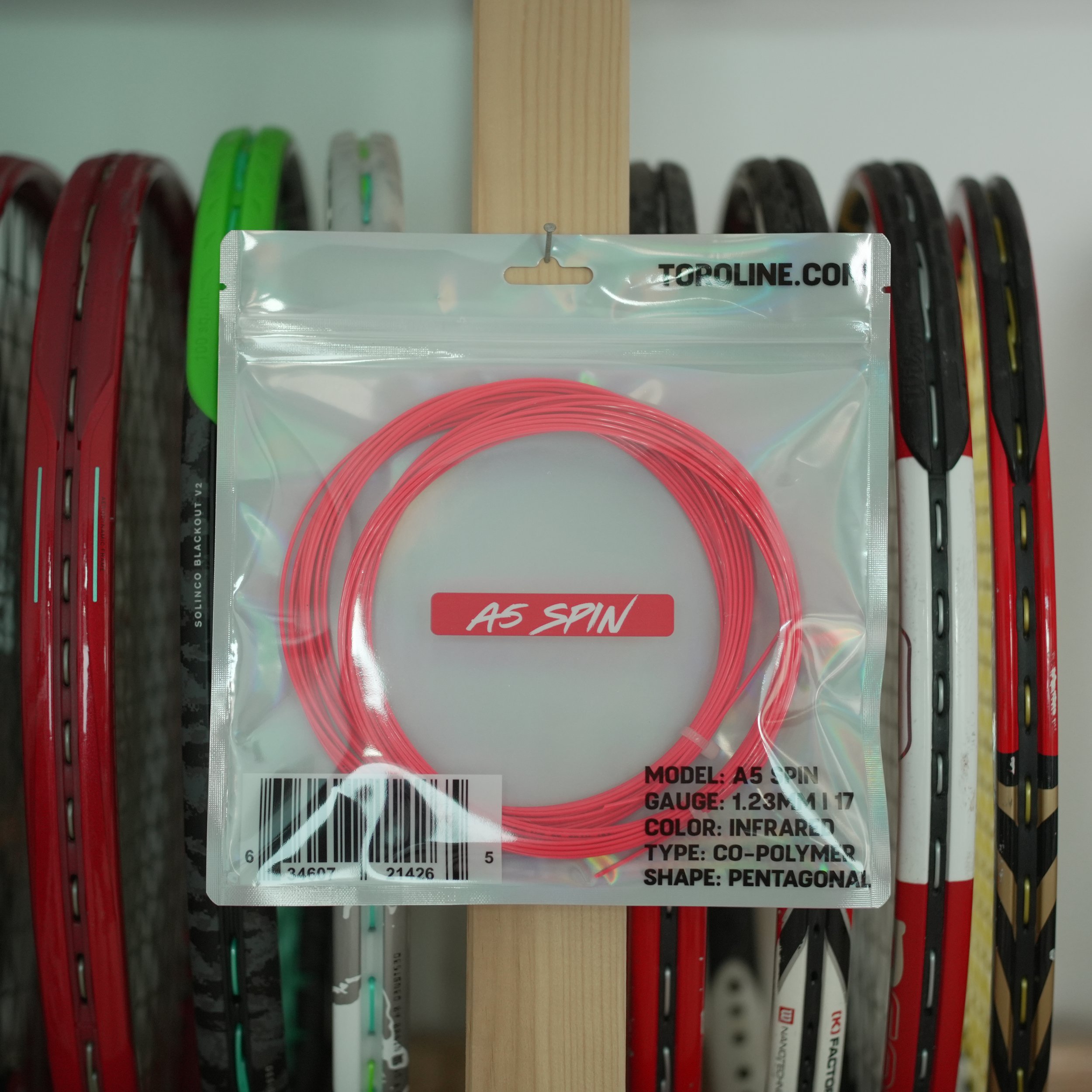
Toroline’s crispest and most responsive formula, A5, in a pentagonal shape for improved ball-grab and list compared to the round version of A5. This is like O-Toro on steroids, offering a more crisp, connected feel without sacrificing comfort, forgiveness or spin.
Available in two two, the 1.25mm Carbon Grey is slightly more controlled with a more solid hitting feel while the Infrared version offers slightly more power with a livelier feel.