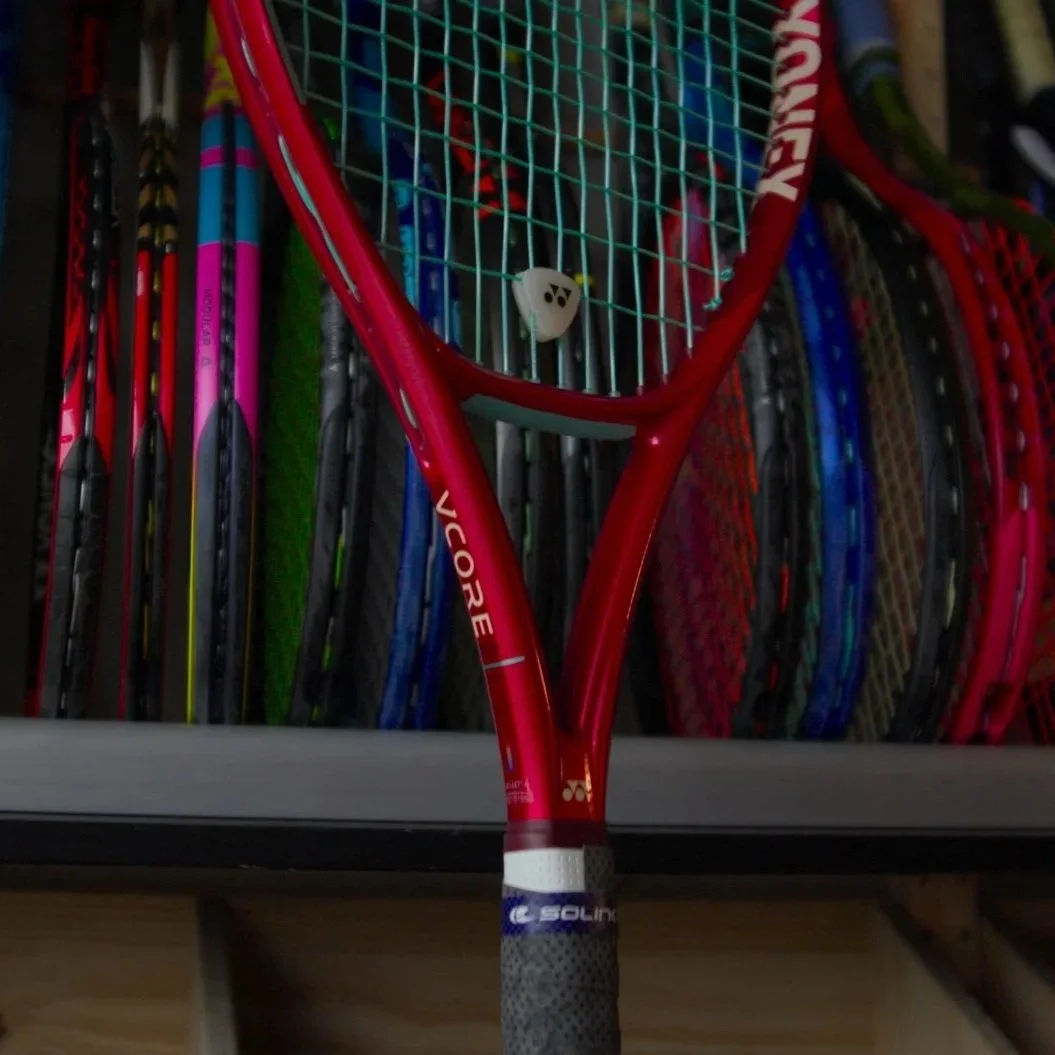
In typical Yonex fashion, the 2026 VCORE’s have seen legitimate technical changes to their mold and layup. The beam has been thickened in two places, first in the shaft which stiffens the throat for a more responsive, less laggy feel and also at 3 and 9 for improved torsional stability and a larger sweetspot. Interestingly, the tip has been thinned down for better control in the upper hoop.
Old VCORE 100 25.3/25.3/22 -> New VCORE 100 24/26/23
Alongside the change in mold, it seems like we are also getting a slightly higher average swingweight. Tennis Warehouse’s samples averaged at 325 strung, which is the same as my copy, marking a marginal, but noticeable, 3 point increase. Finally, the layup has also been adjusted, adding servo-filter to the hoop, avoiding the EZONE’s Minolon update.
These technical changes address all my issues with the previous version.
The sweet spot felt inconsistent with too much launch in the upper hoop compared to the rest of the stringbed.
The hitting feel was a bit mushy and hollow, lacking solidity and purity.
The new mold makes the stringbed and flex feel much more consistent. I’m not saying we have a “control oriented” experience, but the drop-off in feel and playability outside the sweetspot is less significant and more gradual. The new layup and higher swingweight make the hitting experience much more solid and confidence inspiring.
So that’s what’s new with the 2026 VCORE 100, but what does that mean on court?
Power
The biggest standout feature with the new VCORE is massive power. Ball speeds feel higher, spin rates feel heavier and depth comes so easily. The 325 swingweight is a perfect middle ground for me when it comes to combining racquet head speed and plow through.
I wish I had a reliable way of measuring ball speeds indoors but Simon says I absolutely cooked balls. Being on the receiving end of Luca’s (reviewer from Rackets and Runners) balls was also a miserable experience. They came down my throat higher, heavier and faster than usual.
The problem with all this power is that it can be hard to control.
Control
Even though the mold improves stringbed predictability, the power increase is such that you never quite feel in control of what’s going on. Depth and ball speed come so easily and so massively that it’s really easy to overhit. I worry that the VCORE 100 will earn a reputation for being launchy but I don’t think that criticism is entirely warranted.
To me, launchy frames are unpredictable. Launchy frames have string beds that don’t seem to respond consistently to your input. The previous VCORE 100 could definitely be considered to be a bit launchy because the upper hoop had a significantly higher launch angle than the sweetspot in the middle of the frame. This made it sort of feel like it had two sweetspots with a noticeable drop-off in playability outside those areas.
The new VCORE has a clearly defined sweetspot with a minor drop-off in playability, but the sweetspot is so much more powerful than any other mainstream racquet on the market. It makes the Pure Drive 100 feel like a 98 in comparison. I found myself consistently hitting long, regardless of string and tension adjustments. And oddly enough, I think a big part of this story is how this racquet produces spin.
Spin
The VCORE 100 does produce a lot of spin. I especially notice this on the receiving end of things. Playing against players who wield the frame were regularly hitting heavier, high bouncing shots than with their racquets of choice.
What I find frustrating is that the spin modulation doesn’t come that easily. It’s hard to get under the ball and loop up extra spin, something you might need to do when picking up low balls around the service line or resetting the rally with a high margin shot. I’m not exactly sure why I struggled so much in the department. It could be the above average strung twistweight of 14.7. But I tried all my usual tricks, like removing handle weight to get a more head heavy balance and going for shaped strings to get more lift. Overall, I had much more success striking through the ball rather than trying to finesse the ball with spin.
Racquets like the EZONE 100, my Aero Rafa and even something like the Diadem Axis 100 give you better control over your spin application, something I think is sadly missing from the new VCORE.
Feel
I am quite pleased with the feel of this frame. It’s loud on court, kind of like the Gravity 98 or TFIGHTs, so it feels like you are really smacking the ball with power. The VCORE 100 is quite crisp, quite firm and pretty solid.
As we discussed in the opening, the feel is quite a bit more refined than last year. There’s less mushiness, less tinniness. The hitting feel is also a lot more uniform than it used to be. The old VCOREs were quite pure and plush on centre and then became more tinny and brassy off-centre.
The new one feels more crisp and solid across the hitting face while retaining enough connection to the ball to inform off and on-centre shots. With that, there’s less ball pocketing than there used to be, the new VCORE 100 is very much a “point and shoot” frame with a pretty short dwell time, especially if you choose a stiffer string like Solinco Confidential.
If I were to nitpick, I’d say that the feel is a little bit hollow, again, especially with stiffer strings. While the solidity has improved over last year, it’s still mid at best compared to the rest of the market.
The Aero’s (2023) and EZONE’s feels quite a bit more solid in my opinion.
Match Play
When it comes to match play, serves and returns are a big standout with this frame. Once I got my swingweight dialed-in, I was serving quite well. Power and spin come so easily so making high percentage first serves is quite effortless. I felt more than accurate enough to slow down my pace and spot serve and there’s enough consistency from the stringbed to trust heavy second serves.
Returns are also excellent because depth is so accessible and the frame is so stable. Taking returns early, using a short backswing and aiming for the centre of the court is the best way to maximize this frame on returns. Even in completely stock form, the racquet is plenty stable against the harder serves you’ll face at the 4.5ish level.
For me, the main issue for match play is that I found it hard to reset the point with a heavy neutral ball. On the stretch, I found myself flattening it out more than I prefer, which encourages low-percentage winner-spamming over solid defending.
The other issue is that you really have to trust your technique. If you are the type of player that reduces swingspeed due to fear of over-hitting, this is not a good choice. You must maintain high swingspeeds to access enough spin to bring the ball down.
Setups
As I’ve been enjoying lower weight frames lately, I liked this frame a lot stock. I tried increasing the handle weight with a heavier base grip, lightening it with a lighter base grip and adding weight to the hoop, but my best results came with the stock grip and only 1 gram at 12, bringing the swingweight up to 327 strung.
When it comes to strings, I tried Polytour Strike blue, Toroline O-Toro Tour, Grapplesnake Tour M8, my own string, O-Snap and Confidential 16. I played my best tennis with O-Snap at 53/51lbs because it’s the string I trust the most to pull balls down. I think most players will find that setup to be a bit too powerful, but it’s what I like.
Second best was Tour M8 which I think will be a more universal appealing option as it brings the launch angle down while still giving you enough stringbed grip to feel the ball. Control here is much better than O-Snap which is the main issue with the VCORE 100.
Polytour Strike was also quite good but I don’t what to recommend a string that’s about to be discontinued.
Final Thoughts
Overall, in typical Yonex fashion, this is a very solid update that feels objectively superior. A more consistent feel, increased power and a more predictable response.
That said, there are some things that I’d like to see in the future, a whippier swingfeel without a swingweight reduction, a more solid contact feel and a lower launch angle.
In fact, I think it would be really nice if they made it a 16x20… right guys?