Grapplesnake Soldier: Zero Tension Loss
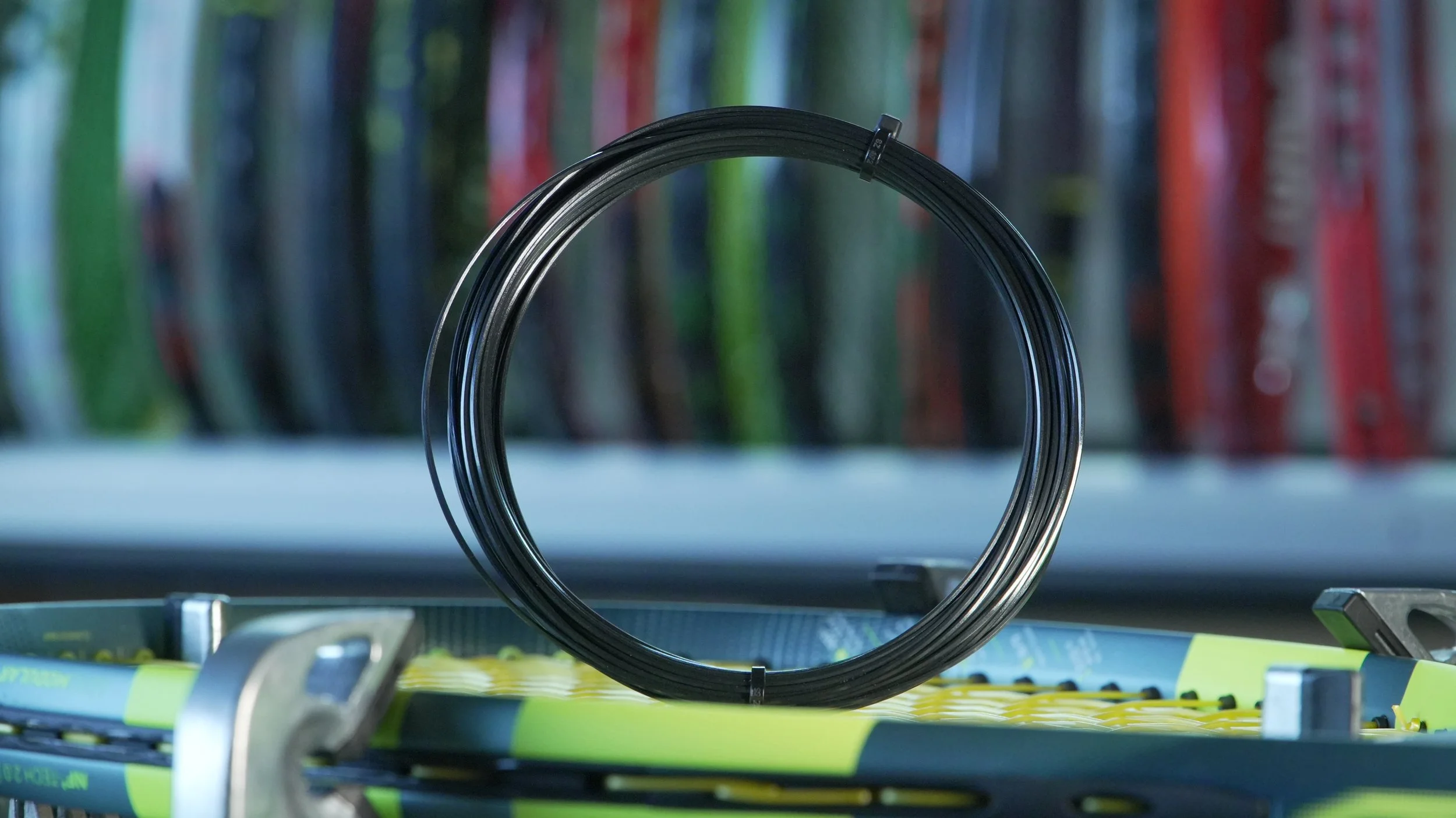
The big problem with polyester strings is tension loss, especially when compared to high-end multifilament nylons or, the king of string, natural gut. In the last few years, we have certainly seen improvements in tension maintenance, not only in from major brands, with offerings like Luxilon 4G, Head Lynx Tour and Solinco Confidential, but also in boutique string companies in ReString Sync, Grapplesnake Tour M8 and Toroline O-Toro Tour. With their newest release, Grapplesnake continues the mission, featuring “a new construction for maximum tension maintenance and long playability duration.”
So let’s put that to the test.
Tension Maintenance Test
All racquets were strung by me, Beckett (trained MRT, formerly certified by the USRSA) on a Gamma X6 FC with a Wise Tension head. The stringing method was 2-piece on every racquet and knots were NOT bumped up prior to tie-offs. Dynamic Tension was measured with the ERT300.
Yonex VCORE 95 (2023) @ 45/43lbs:
Fresh off the machine: 30DT
After 30 minutes of play time at 1 week of resting: 28DT
After 4 additional weeks of resting: 28DT
Head Speed MP Legend (2025) @ 49lbs:
Fresh off the machine: 31DT
After 12 hours of play over 1 month: 28DT
Tecnifibre TFIGHT 300S @ 48lbs
Fresh off the machine: 31DT
After 80 minutes of hitting and 1 day: 29DT
After an additional 60 minutes of hitting and 1 day more: 28DT
So we’ve got less than a 10% drop in dynamic tension across multiple racquets through their respective playability durations. This is pretty outstanding when compared to Tennis Warehouse’s database, where the top performers score just under 20%. I would not take this that seriously though because I’m not exactly sure how TW derives their data.
One important piece of information is that Soldier loses basically all of its tension in the first hit and then levels off. For many players, this is a good thing because you’ll be “breaking in the string” during the first hit, to be rewarded with incredibly consistent playability for the remainder of the string’s life.
Break In Period
I personally don’t believe in the concept of a break-in period for strings. With few exceptions, tennis strings are designed to play their best right after stringing so pro players can get the best playability right away and then switch racquets to fresh strings again. I’ve seen some people experience the break-in period with some of my favourite strings, like Solinco Confidential or Tour M8, but I think this is really more about that initial tension drop.
If you aren’t using fresh strings on every hit, you’ve probably become used to a much looser stringbed than your reference tension would indicate. This suggests that you probably actually like the feel of a string more after than initial tension drop because it plays more like the used strings you’ve become accustomed to. While Soldier does have an initial tension drop, that’s not where the break-in period reveals itself.
Soldier, like Grapplesnakes last 3 releases, features the abrasive texture, meaning the surface feels like a fine grit sandpaper. With their round offerings, Mako and Paradox, snapback is available immediately due to the profile of the string. With the shaped strings, Aspera Triplum and Solider, you’ve got to work through that grit a little bit before the string starts sliding on itself.
This made me pretty mad to be honest. I personally want my strings to play well immediately because I’m constantly stringing new racquets to review. When I first tried the string in the FX500, I rage quit the session and complained to Grapplesnake immediately. They said “trust me,” play through the string and it’ll start snapping back.
They were right.
Once I got through the break-in period, I was rewarded with some of the best spin and control I’ve experienced in any string.
Playability
Soldier does not play like other strings. But if I had to place it somewhere, I’d say you get the general hitting feel and solidness of Solinco Confidential, the ball-pocketing of something like Tecnifibre Triax, which is a multi by the way, and the grip of the ball of ALU Power Rough.
Usually when you combine big ball pocketing with big grip, you are punished with terrible control. Aggressively shaped strings like the square Ultra Cable, YTEX Quadro Twist or some of Grapplesnake’s older strings are guilty of this. If you don’t constantly apply a lot of spin, you might catch an edge and spray the ball long. Overly soft poly’s with major pocketing, like Toro Toro or Polytour Drive Soft can also introduce a major trampoline effect that makes it difficult to fully swing out. Soldier, on the other hand, combines big grip with deep ball pocketing.
The string itself is quite low powered, so Grapplesnake recommends dropping tension by 3lbs. I dropped the tension in my Rafa from 51lbs to 45lbs and that felt about perfect. That said, I do use a relatively high powered setup with O-Toro, so if you are coming from something more normal, like Hyper-G or RPM Blast, the 3lbs drop should be enough.
This drop in tension is key to opening up the string to create more string movement and deepening the ball pocketing. Usually these low tensions mean massive power, but in Solider’s case, it's more about re-balancing the power levels to “normal” and lengthening the dwell time.
Spin
Soldier is a dual-textured string, meaning we’ve got the abrasive surface and a sharp 7-sided extrusion. The shape feels similar in sharpness to Tourna Silver 7 Tour, which is pretty sharp considering it’s got a lot of sides. The abrasive texture both increases your grip on the ball and creates more of a spinny-noise on the stringbed. Unlike some of the slicker, glossy strings, like O-Toro, which can sound pretty quiet, Soldier is louder, so you can really hear your inputs, how much the string is snapping back and responding to your swing.
All-in-all, spin isn’t necessarily top-tier, as we are missing the free-flowing snapback from O-Toro and ReString, or even RPM Rough, but the massive grip on the ball keeps things in line with Hyper-G or Lynx Tour.
What is important is that you really have to work for your spin.
The Demands of Soldier
In racquets that I prefer to hit flat, like the FX500, I really struggled with control. I found myself failing to properly get under the ball and close the racquet face after contact.
In racquets that I prefer to hit with more spin, like my Rafa, this VCORE 95, the TFIGHT 300S or the Simon’s Speed MP, spin and control came much more easily.
Soldier demands a loose wrist and commitment to your shot. Intentionality is key. This sounds stupid and obvious, but my best results came when I stayed committed. Soldier isn’t forgiving or powerful enough to support willy-nilly defensive play. Floating around the baseline, hitting 60% effort neutral rally balls, daring your opponent to miss is not what this string accels at.
The tag line for this string, “there’s a mission that needs to be done,” while a bit gauche, is quite apt. Soldier wants you to go for your shots. If you want to control the point with power and spin, do it. Just make sure you commit and let your arm and body flow through the shot. If you want to control the point with slices and drop shots, that’s also 100% viable, just make sure you knife your slices authoritatively and cup the ball carefully.
Recommendations
I’d recommend Soldier for two types of players.
Someone who already goes after their shots and likes controlling the point actively.
Someone who’s working on dictating with power and spin but needs a reminder to stay on the gas.
I think this would work great for someone who likes Confidential but might be looking for more ball-pocketing and comfort, or someone who likes the feel of high-grip or aggressively shaped strings, like ALU Power Rough, or Ultra Cable, but is looking for both better control and a longer playability duration, as Soldier both holds tension better and resists notching better than your typically extremely textured strings.
Final Thoughts
Some final thoughts on Grapplesnake Soldier and Grapplesnake in general. Soldier is a weird string. It’s definitely a poly, but it doesn’t really play like anything else on the market. Because of this, I absolutely hated it at the start.
It also took me several sessions and several different racquets before I fully appreciated what it has to offer. Soldier probably won’t impress you on your first hit. It might not impress you on your second hit. But once you get to know it, once you come to appreciate what it offers, and how you can play to get the most out of it, it truly offers something not only unique, but valuable.
Thinking back to the early 2000’s when people were just starting to use poly, not everyone liked it, and not everyone appreciated it for what it was. Ask anyone who used poly back then and they were probably stringing in the high 50’s or even 60’s. Today, we know that’s not the way to get the most out of poly. That’s how I’ve been feeling about Grapplesnake’s last few releases, but especially Soldier. I’m so used to my Toroline stuff that I’m really just looking for a string that’s a plug and play substitute with big snapback. But it’s possible that there’s more out there than just that.
Soldier was a nice reminder for me to keep an open mind on evolving technologies, instead of pining for what I’m used to. This idea that “everything is better in the past,” is an idea that, I think, hurts tennis overall. And I hate when I’m guilty of it.
So salute to Grapplesnake for doing something different and producing 4 consecutive strings that are truly unique.
Paradox Pro
Tour Mako
Aspera Triplum
Solider
Let’s see what you do next.