V10 Blade 98: 16x19 vs 18x20
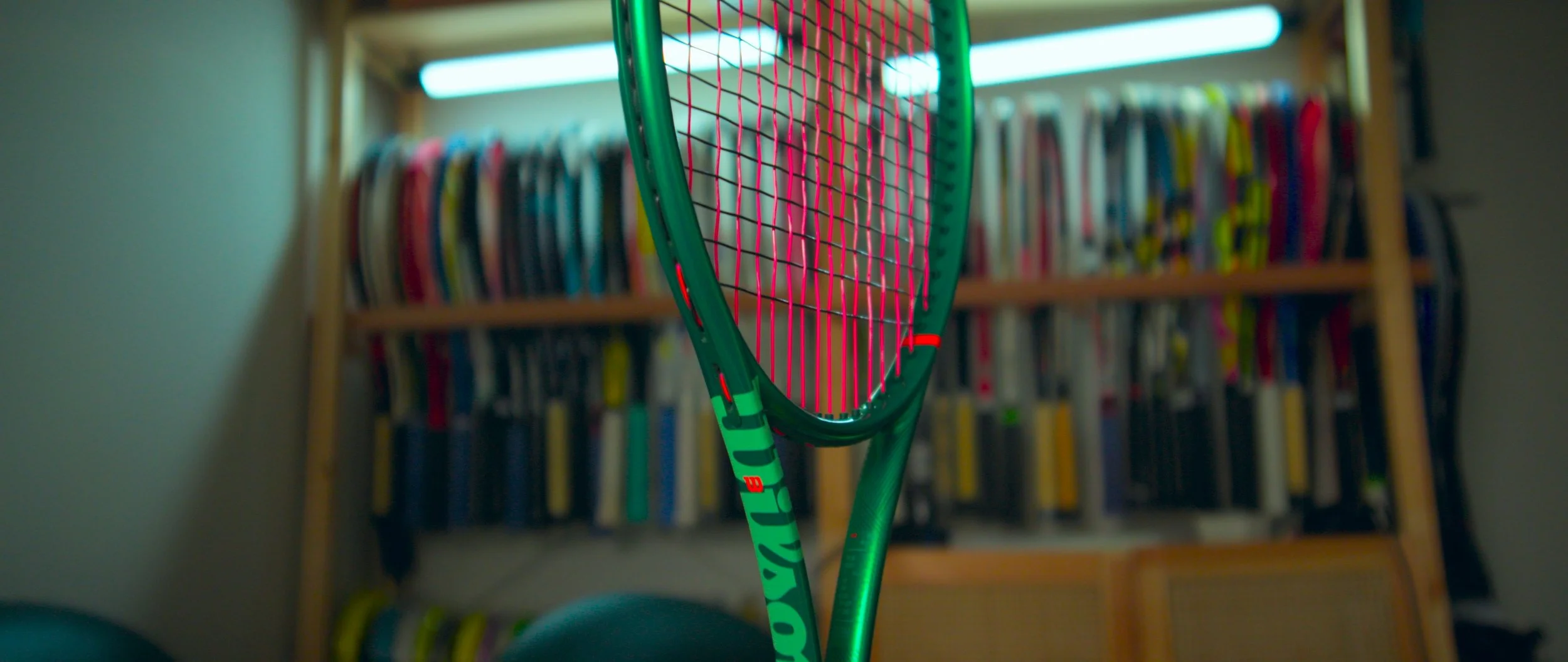
The V10 Blade 98 brings some major technical changes for 2026. We’ll analyze how those changes influence playability on court, compare the two string patterns, 16x19 vs 18x20, and go through optimal string and customization setups for the new Blades.
What’s New
For the first time in the Blade’s history, we now have a tapered beam, meaning that the beam now increases in thickness towards the hoop of the frame. In the throat the beam is quite thin, at 20.5mm, increasing to 21.5 at this red line. You might be thinking that this is going to turn the new Blade into a total clunker, but I’ll remind you that the 2015 Blade, regarded by many as the greatest Blade of all time, actually had a 21.5mm flat beam. It wasn’t until the notorious CV Blade that they decreased the thickness to a 21mm flat beam.
Usually when beam thickness increases, stiffness also increases, but the thinned down throat actually means that you’ll see slightly lower RA’s on the V10 Blades compared to the V9’s, but honestly, on court you don’t feel much of a difference in flex.
The rest of the specs go pretty much unchanged.
Comparison to Previous Versions
For the VX Blade, I took a quick trip down memory lane to test the V9, 2015 and kBlade. The standout differences between the V9 and V10 are all about additional forgiveness. The actual hitting feel and swing feel are pretty close between them, but the V10 is more forgiving off-centre, creates more power on-centre, loops on spin more easily and is much more stable all around.
The new swing-feel might be a little more polarized, with the V9 feeling like there might be more mass centrally located, but honestly, that could easily be down to QC across different models.
The 2015 Blade feels way more alive, the feel is crisper and more responsive, but the overall playability is more demanding. Those old Blades were more head-heavy with a 32.5cm balance point so you can feel more mass above the handle which might feel a bit slow to some players. The main thing that I noticed is that the 2015 Blade doesn’t produce spin or lift as easily as the V10 and the 2015 is more punishing off-centre.
The kBlade is actually super nice, even with the 18x20 being the only available pattern, you can create decent lift and spin with the frame and power is surprisingly high for a frame of that vintage. The feel is, again, more connected and the higher swingweight requires more from the user, making it overall less forgiving.
String Patterns
The Blade is available in two string patterns, 16x19 and 18x20. I tried both, though I spent most of my time with the 16x19. The majority of this review is based on my experience with the 16x19, however, I don’t think playability between the two versions is that different.
The main difference is a lower launch angle on the 18x20 and better directional control. It’s still possible to create a decent amount of spin with the 18x20 and the 16x19 still offers a ton of control on flat balls. If I personally had to switch to one of these Blades, I’d probably choose the 16x19 simply because it takes less time to string. That said, if I was buying a Blade to add to my collection, I’d choose the 18x20 because I think it suits the character of the frame more authentically.
At the end of the day, the Blade is a racquet that plays best on attack, penetrating the court with flatter, more precise shots and carving knifing slices, all things that 18x20’s tend to do better than 16x19’s. All in all, the difference between string patterns is relatively subtle, something like a VCORE 100 vs 100D or a Speed MP vs Speed Pro is going to provide a more exaggerated difference in playability than we have with these Blades.
Feel
So like with the V8 and V9 Blades, the feel here is relatively muted and I don’t think things have changed much. You don’t feel that crispness or sharpness that you’d find with a Radical MP or TFIGHT 305S, but you do get a very solid overall hitting experience. I think this feel is much more justified with the V10 Blade because the racquet holds up to pace and off-centre balls a lot more confidently. On balls where the V9 would have been bullied, the V10 plows through.
This justifies the muted feel on the V10 by making it feel solid, whereas the weak torsional stability on the V9 made the mutedness feel empty leaving you wondering why your ball flubbed into the net. Because this racquet is so muted, I found myself often preferring to forgo the dampener on the V10 because it helped me feel where I made contact on the stringbed and it improved my sensation of ball-pocketing.
That said, at lower tensions I preferred to keep a dampener in because the enhanced dwell time of the lower tension helped me stay connected to my shot.
Stability
Stability is the primary area of improvement on the new Blade. With the V9, the combination of a thin beam, medium swingweight and lower twistweight made the racquet kind of suck on off-centre shots. Spin, power and control all suffered. The newly thickened beam, or arguably, the re-thickened beam, means that playability off-centre is way better.
If you are able to keep your swingspeed up, even when out of position, you can still create a lot of spin and power with this racquet, effectively modernizing the Blade, helping it compete with popular racquets like the TFIGHT 305S and Aero 98. While this stability is great for improved defense, I think it’s best utilized for offense.
Better stability with the Blade means it’s easier to take the ball early and take time away from your opponents, whether it be my taking returns up in the court or hitting rally balls on the rise and playing all-court tennis.
Spin
Spin is the second most improved area on this frame. While I still can’t exactly say that the Blade, even in 16x19 form, is a spin monster, I was able to generate some pretty spin RPM’s with this frame.
The racquet pockets nicely so you can really feel the ball sit in the stringbed, get grabbed by the strings and shoot out with whatever kind of spin you chose to apply. Spin modulation is quite solid on two counts: not only does the stringbed do a good job of responding to your inputs, delivering a 1-to-1 response, but the swing feel is easy to modulate. If I wanted to loop up big net clearance to buy myself time, I could, if I wanted to drive through the ball with tight spin, I could and if I wanted to smack a flat ball, I could.
Slices are also excellent, they stay low when you knife them but you can also float the ball if you need to buy yourself time on defense.
Power
Power is the third most improved area on the Blade. On-centre power, specifically, if phenomenal. When you get the racquet lined up and you can shift your weight through the ball, there’s a ton of power and it’s very easy to penetrate the court. The drop-off in power off-centre is also managed quite a bit better.
I felt with the previous version that when you missed central contact, it was impossible to create a penetrating ball. With the V10, the drop-off is less severe so the sweet spot feels more generous and forgiving.
Control
With all this improved power and spin, you are probably expecting this racquet to have sacrificed some control, but I don’t think that’s true at all. I felt extremely confident going after my shots from all areas of the court when using the Blade. I think the improved stability actually increases the predictability from the stringbed because the racquet doesn’t flutter or twist anymore, instead you are treated to this rock-solid feel that we seldom find in the 305g weight class.
The 16x19 is more than dense enough to provide a consistent response on flat shots, offering both predictable direction changes and solid depth control while also delivering the exact spin you expect depending on your inputs. Of course the 18x20 is always going to be the better option for pure control, but the 16x19 is no slouch.
Everything Bad
So I’ve delivered a very glowing review until this point and now is when I tell you about the bad stuff. In my opinion, this racquet has 3 main cons, assuming you don’t mind the slightly muted feel, 4 if you do.
Number 1, this racquet can be a bit slow.
The V8 and V9 Blades do seem to be more maneuverable frames. This might be due to the thinner beams of the old version, but I also think that the weight distribution on the V10 is supposed to be more polarized, meaning the weight is shifted further up the hoop. This weight up the hoop is a big reason the racquet is so much more powerful and stable, and I personally think that the trade-off is absolutely worth it, but if you are expecting a super-speedy Blade, this ain’t it.
Number 2, this racquet is punishing on the back-foot.
Now to be clear, I think ALL Blades are punishing on the back foot. They are supposed to be player’s frames, which are, by definition, less forgiving when you are out of position. I had a few days where I really struggled to find my best tennis with this frame due to having very tight hips and lower back.
Now of course, when you aren’t feeling your best, you won’t find your best tennis with any racquet, but the Blade’s punish you more than most racquets on those off-days. If you aren’t seeing the ball clearly, have a slow first step or are playing against a better player who rushes you, the Blade will quickly become your worst enemy. You must get your body weight moving through the shot with high swingspeeds to make the most out of this frame.
Number 3, I think this frame is surprisingly string sensitive.
I’ll get into the specifics more in the strings segment, but if you string too tight or use too low-powered strings, this racquet can turn into an absolute board which only amplifies how punishing it can be on those off-days.
Setups
I tried the V10 Blades with a few different customizations and in 6 different string setups.
ALU Power @ 53lbs
A5 @ unknown after plane
RPM Blast @ 53lbs
Sniper/Sync @ 46/44lbs
O-Toro Tour @ 49lbs
O-Snap @ 44lbs
My favourites were Toroline A5 and my O-Snap at 44lbs.
A5 is great because it balances the crisper, more connected ALU Power type feel that you want for these Blades while offering better forgiveness, massive spin and longer lasting playability.
My next favourite was O-Snap at 44lbs, partially because I think it looks really good in this Blade, but it also helped me increase the forgiveness of the frame without losing control.
The worst setup was Tour Sniper/Sync at 46/44lbs. Somehow, that setup played more dead and boardy than Luca’s RPM Blast at 53lbs. Part of that is definitely weather related, as I used Sniper/Sync outside on a colder day, but it almost ruined the racquet for me, which is weird because on paper that could have been a perfect setup.
Overall my recommendation is go for a softer, looser setup than you might think you can control because the inherent predictability of the Blade is so high that you can really extract a lot of power and spin just from the strings you choose.
When it comes to weight setups, I liked this racquet most stock. Interestingly, I tried 3 different Blade 16x19’s, mine, Luca’s and Jonas’. Luca and Jonas definitely had faster feeling samples than mine. The difference wasn’t crazy, as they’ve tightened up QC for the V10’s, but I think the higher balance on my copy made it a bit more sluggish, though I’m not sure because I don’t know their specs exactly.
I did not feel that this racquet required lead tape, because the power and stability were quite strong in stock form. For fun, I also tried the no-base grip technique which honestly made the racquet worse, less stable with worse swing-feel. Then for even more fun, I tried a leather grip on Luca’s which felt pretty nice, though it slowed down the racquet through the slot.
Generally, I think this racquet plays fine stock, and I’d recommend for most players in stock form or with a leather grip if you do like a more headlight frame.
Final Thoughts
Overall, I think this is my personal favourite Blade of all time. Does it feel as good as the V5? No, but it offers so much more playability.
Tennisnerd actually told me I should switch to this racquet after we tested them. Given that I loved this racquet on serve and from the ground, honestly I probably could switch. I’m not going to, but I do think that this is the exact update that the Blade needed.
Wilson has modernized this frame in a way that helps it keep up with the competition, while taking inspiration from several previous Blades to keep the user base happy.
Whether you are a V8/9 lover or a 2015 supremacist, I genuinely think that you’ll enjoy this frame, because I sure did.
Support the creation for future tennis content just like this through our affiliate links.